Thursday, February 19, 2015

Springtime in Cefalù -- in February!

Having a gelato on the steps of Duomo de Cefalù
Today was the last of our 3 blissful days in Cefalù.  We had originally planned to spend our first few Sicilian days in Palermo, the destination of our Easy Jet flight. But we're not fans of noisy cities or of being herded around with groups of tourists, so we weren't as excited about Palermo as we felt we should be. It occurred to us, finally, that perhaps we should move our plans to a smaller town for our first few days in Sicily, and that's how we chose Cefalù, about 70 km east of Palermo. The thought of arriving in Palermo at night and speaking only one word of Italian was overwhelming, so it was a relief to find an Air B&B host who would pick us up at the airport (for a small fee: 80 euros), and whisk us to our B&B, without our having to think. Sometimes it's nice to have someone hold your hand when you're being a mighty adventurer.


This is not the view from our room.
Cefalù, as it turned out, was the perfect size town in which to start our Sicilian adventure, with plenty to see and do for a few days, all within easy walking distance. We had a beautiful view of the Tyrrhenian Sea from our room, so when we were tired of walking, just being in our room was a treat. 
This is the view from our room, with La Rocca on the right


We spent the first two days wandering around the streets, walking on the beach, and sitting on benches like the old men do. The "old men," come to think of it, are likely Gary's age or even my age! At any rate, I suspect all of Sicily is made for this: you just sit on a bench and look around, and you're completely entertained. 

A tabletop near the Duomo. I want to learn to paint in this style.

Today (February 19), the forecast was sunny and warm (57 F), so it was a good day to climb La Rocca -- The Rock -- a 270-meter promontory that towers over the town of Cefalù. So this morning, after stopping at the little grocery downstairs from our B&B for bread, salami, and aged provolone cheese, we headed up The Rock.

It was a bit of a slog, but not too bad, and all along the way were places for taking photos and reading about the history of La Rocca, which dates back to the fifth century B.C.  Back then, the town was perched on top of this hill, where the people felt justifiably safe from invaders. I will say, after hiking up there,
Spring flowers -- in February
that it must have been a safe bet that no one who made it to the top would have any energy left to rape and pillage. I can imagine a group of invading Romans or Saracens or whoever — there were so many, it’s hard to keep them all straight — arriving at the gate, clutching their hearts.


The higher we got, the bluer the Tyrranean Sea. 

Looking down at Cefalù


The site of lunch, Thursday, February 19, 2015

At the top, we rewarded ourselves with lunch, sitting on top of the castle wall. Not everyone makes it up this high, apparently. According to TripAdvisor accounts, some folks stop at a lower level, afraid to go any higher (ha! As I climbed to the top in my low-heeled shoes, I kept thinking of Lily Tomlin's line "Are you a woman or a wouse?"). So we were puffed with pride, having made it to the summit.

Yesterday, I had my first ricotta-filled cannelloni (a mini-one, for starters) with a glass of cafe latte, for my afternoon treat. I will have another, and another, and will try the other tempting pastries in Sicily as well, in the coming days. 

Wednesday, February 18, 2015

Buongiorno, Sicily!


The view from our Air B&B. Our hostess, Luisa,
was born in New York, but her parents moved
back to Sicily when she was 14. She still has a
strong New York accent -- adorable!
We spent the day yesterday — our first day in Sicily — wandering starstruck around the town of Cefalù (pronounced cheff-a-LOO). We had no idea it would be this wonderful: history, friendly residents (speaking Italian, yet!), jaw-dropping sights, charming narrow alleys with laundry hanging from balconies, great food, blue ocean, gelato. 

No one seems to know exactly when or why the town of Cefalù came to be, but its first mention in history was in 396 B.C. The entire island of Sicily has such a mind-bogglingly rich history -- having at one time or another been under the rule of Greeks, Romans, Arabs, Normans, a few bishops, the Kingdom of Italy, the Mafia, modern Italy, and at times, no one at all -- that I can't even begin to sort through it. Happily for us, each culture left a bit of itself behind, in cathedrals and mosques and mummies and mosaics and menus, and now all we have to do is bask in it all. With gelato!

Our little Nikon Coolpix isn't up to the task of capturing the beauty, so none of these photos do it justice, but here's a little bit of Cefalù. 


Chiese del Purgatorio (Church of Purgatory). Baroque, decorated with figures in purgatory

Pastries and marzipan!

The Cathedral of Cefalù (Norman)

The town of Cefalù, from the beach. In person, it looks a lot cheerier!


A Cefalùean shopper

Cefalùean tourists, waiting for our first Sicilian meal: an arancina filled with prosciutto and mozzarella, and a slice of funghi pizza. Molto buona!

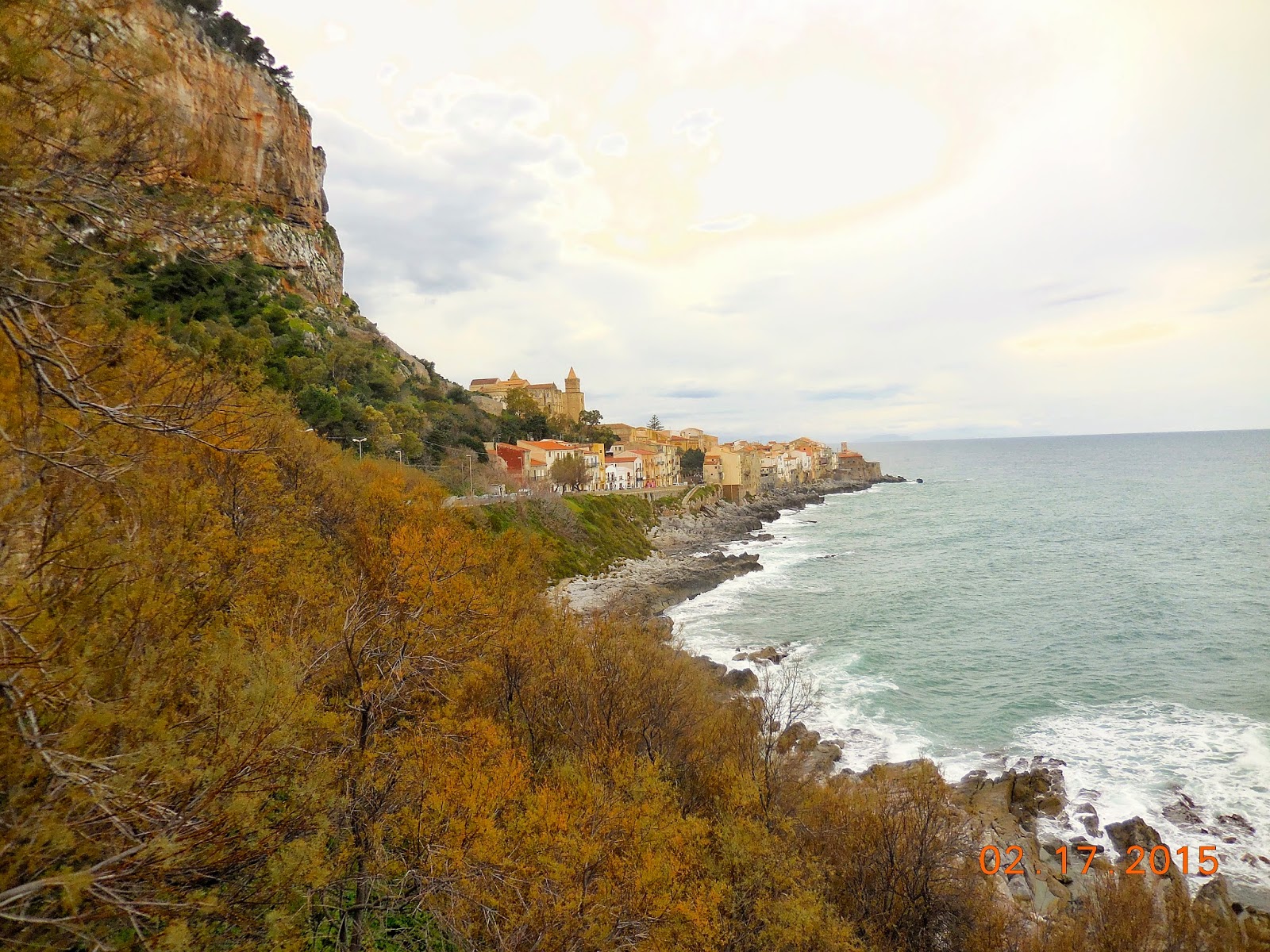
Looking west, toward Cefalù

Gary timed the waves, and said we could make it over these rocks and across this bridge with time to spare. I turned around and went back the way we came. A few minutes later, he did, too.

In summertime, these streets are probably a little more crowded. There's a handful of tourists in town already (although the busy season starts next month), but during siesta, from 1:00 to 4:00, only a few shops are open and the streets feel relatively empty.


The Lavatoio, a medieval laundry room. Water collects in these pools and runs out to the sea. 

It being Fat Tuesday yesterday, we had a serendipitous moment when we caught the tail end of the local schools' Carnivale. The schools apparently let out early, and the kids dressed up and paraded down the street, throwing confetti. All afternoon, we saw parents walking hand-in-hand around town with miniature princesses and princes and devils and clowns -- and not one single character from Frozen.


The traffic in Cefalù is hair-raising, and we are glad we opted to not rent a car. The streets in town are just barely wide enough for a car to pass, so we often had to stand aside to let cars by. We witnessed one scene where a delivery truck driver stopped his truck in the middle of the road, ran like mad to deliver a package, sprinted back to his truck to relieve the traffic piling up behind it, and discovered that he'd misplaced his keys. A local carabinieri (policeman) sent the driver off to retrace his steps while he calmly directed traffic, puffing on a cigar. As usual, I was itching to snap a photo, but I didn't think anyone was in a photo-op mood! (But we saw him today again, and I snapped this photo on the sly:)


Sunday, February 15, 2015

Tschüss, Lübeck!

Today (Sunday) was our last day in Lübeck. We had a full day, starting with cleaning our flat and morosely piling our luggage by the door. Late in the morning, we treated ourselves to a classical piano concert at the Balsamico Bistro across the courtyard from our flat, to hear some Liszt and Beethoven by Daniel Fritzen, who is so darn cute you can't believe what he can do to a piano. Excellent! I would have snapped a photo but I didn't want to disturb him. 

After the concert, Peter and his partner, Marin, drove us up to the coast for one last walk along the Baltic. Along the way, Peter pointed out some points of interest, like the former East/West German border just east of Lübeck, in the area near Schlutup. They left this East German watchtower up, as a reminder, but no one really wants to remember those dark days. Still, I'm fascinated by the whole Cold War thing, and Peter obliged me with lots of interesting information. 

We passed a beautiful lake called the Dassower See, which reminded us of our own Big Sandy Lake. Peter told us that the city of Lübeck owns the entry to the Dassower See from the Trave River which, back in the day, precluded the East Germans from building a border there. So to get around the problem -- so to speak -- they built a wall around the entire lake. If you had a nice view of the lake, in other words, you got to kiss it goodbye for the duration of the Cold War, and look at a wall instead. I can't even fathom how depressing that must have been. It took a few years to finally take the wall down after Reunification, and it’s hard today to imagine anyone thinking that walling off a lake would be a great way to win hearts and minds. 

On our drive, Peter told us about what it was like to enter East Germany shortly after Reunification. He said he'd been anxious to see it, as he imagined it must be beautiful there. East Germany was as remote to him as a foreign country, despite being just a couple of kilometers away. The reality was that the nature was beautiful and preserved, but the villages and cities were not: West Germans would call the former East Germany “Dunkel Deutschland” (dark Germany) because all the houses and buildings were the same color of gray, and in dire need of repair. 


When we arrived at the beach area, Peter and Marin treated us to an excellent soup for lunch at this sweet cafe, where lots of Lübeckians stop before or after their Sunday walks on the beach . . .


. . . after which we walked past these fabulous multicolored sheep . . .


. . . and arrived at this little road, parallel to the sea, which Peter told us used to be fortified and constantly patrolled, to keep people from getting to the beach. 


My incredulous response to this bit of information was, “Were they trying to make everyone as miserable as possible??” Peter's answer was that they had to go to great lengths to keep their brightest and best from escaping. It's hard to imagine that anyone would think that system was a good one, but as Peter pointed out, many of the people who lived in the East put all their energy and faith into this system, hoping it would work. They were devastated when it failed so spectacularly. 


Fortunately, we were able to walk unimpeded to the beach, where the Baltic was so high that we had to stick to the high ground, as there was no beach to walk on. There's not much of a tide in the Baltic; the water level changes depending on the speed and direction of the wind. Peter said he's never seen the water as high as it was today, that normally the beach is wide in this wild part of the Baltic that was off-limits to Westerners -- and Easterners -- for so many years. 


Along the way, we looked for bernstein (amber) and flint with holes in it (the name of which I forgot to write down). Marin scored a piece of flint with a hole in it! I found a couple of pieces of what might be bernstein but probably is not. (They say that there's a form of phosphorus that many people mistake for amber, that will burn you if you stick it in your pocket. So I kept a close watch on the stones I'd picked up, just in case I'd mistakenly picked up the hot stuff.) 


The place was stunning and beautiful and I hated to leave it. But we had to go, and stopped back in at the Cafe Strandgut for some gooseberry kuchen and milchkaffee -- which cheered me up immensely -- before we headed back to Lübeck. On the way back, we took the little car ferry to Travemünde (a 1-minute ride at most), and Peter & Marin showed us where the fishing boats come in there, which we had never seen before. They are preparing to do away with this area to make way for some luxury apartments: people love the character of this place so much, they all want to live here. Unfortunately, there will be no more character left by the time they move into their deluxe apartments. We're so glad we got to see this, before it's gone forever. 


After a quick once-over of our flat and loading of luggage into the car, we were off to the bahnhof. We will stop back in Lübeck to pick up our luggage in 10 days (universe willing), so we didn't have to say goodbye to it just yet.

Tonite we are in an airport hotel -- the Leonardo -- near the Hamburg airport. Tomorrow we depart for Sicily, and I will be blogging from there. 


Saturday, February 14, 2015

Winding down our stay in Lübeck

Our daily walks around Lübeck are starting to feel poignant and bittersweet: we're leaving tomorrow, and are starting to do things for the last time. We visited the last of the Lübeck museums yesterday -- the natural history museum -- checked out our favorite thrift shop for the last time, and bought one last bottle of pinot grigio at Aldi for just 1,99 euros. (I never knew wine was so cheap in Germany! And it's very decent wine, too.)

One of our favorite lunch spots while we've been here is the Cafe Hansehof, a little cafe tucked away on the second floor of a courtyard in the heart of Lübeck. 

Yesterday we stopped there for lunch, and Gary had kohlrabi soup. I had never considered kohlrabi for a soup before (being new to real cooking as I am), and I definitely wasn't expecting it to be so good. I didn't ask for the recipe but this one sounds about right, from the About Food website:

Hungarian Kohlrabi Creamy Soup

2 T butter or bacon fat
1 medium onion, chopped
1 pound kohlrabi bulbs, peeled and chopped
2 1/2 cups chicken or vegetable stock
1 bay leaf
2 1/2 cups milk or cream or half & half
Salt and pepper to taste

Saute onions in fat about 10 minutes, until soft. Add kohlrabi and cook another 2 minutes. Add stock, milk, and bay leaf, bring to a boil. Cover and simmer 25 minutes, or until kohlrabi is tender. Let cool; remove bay leaf. Using an immersion blender, blender, or food processor, puree soup. Strain if kohlrabi is especially fibrous. Season with salt and pepper, and serve with hearty bread. 

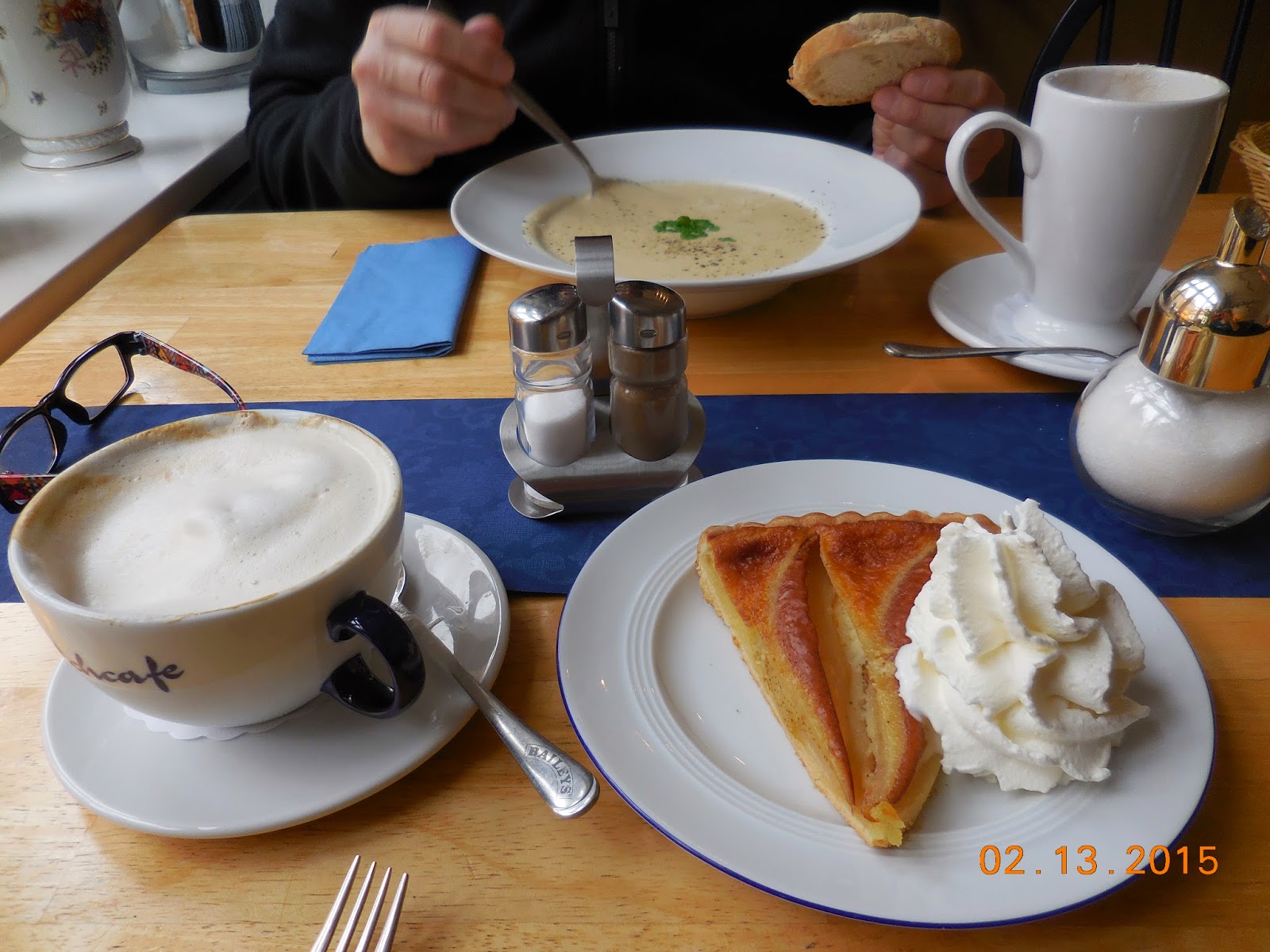
As for me, I chose to have dessert for lunch while I still can, and chose the homemade pear tart, mit sahne on the side.


Here's the view out the window at our table, over some old tile rooftops.


And here's the proprietor, who gave us a jar of marmelade when we announced that it will be our last visit. When you're traveling, you need all the friendly faces you can get. 


Later in the evening, because it was our 11th wedding anniversary, we took our landlord, Peter (Herr Messerschmidt), and his partner Marin, out for dinner to a restaurant of their choice. They chose a fun Italian place on a boat anchored nearby, so we strolled over there, and had one last glass of wein in Peter's flat before saying goodnight. It so much more pleasant to go out for dinner when you don't have to drive on icy roads for an hour each way, and when you have these two to go with. Here we are, hoping I set the camera timer right. 


Wednesday, February 11, 2015

Stralsund and Greifswald

We got back to Lübeck last night from a 2-day trip to Stralsund and Greifswald, along the Baltic coast. 

Stralsund, founded in 1234, is another former Hanseatic/former Swedish/former East German city, nearly due north of Berlin. It's encircled by three swan-filled lakes and the Strelasund sound, which separates the city from the the giant island of Rügen on the Baltic Sea. 

Stralsund is a small version of Lübeck, and even has the same kind of "show facade" on its old city hall that Lübeck has, which was built to show off the wealth of the city. 


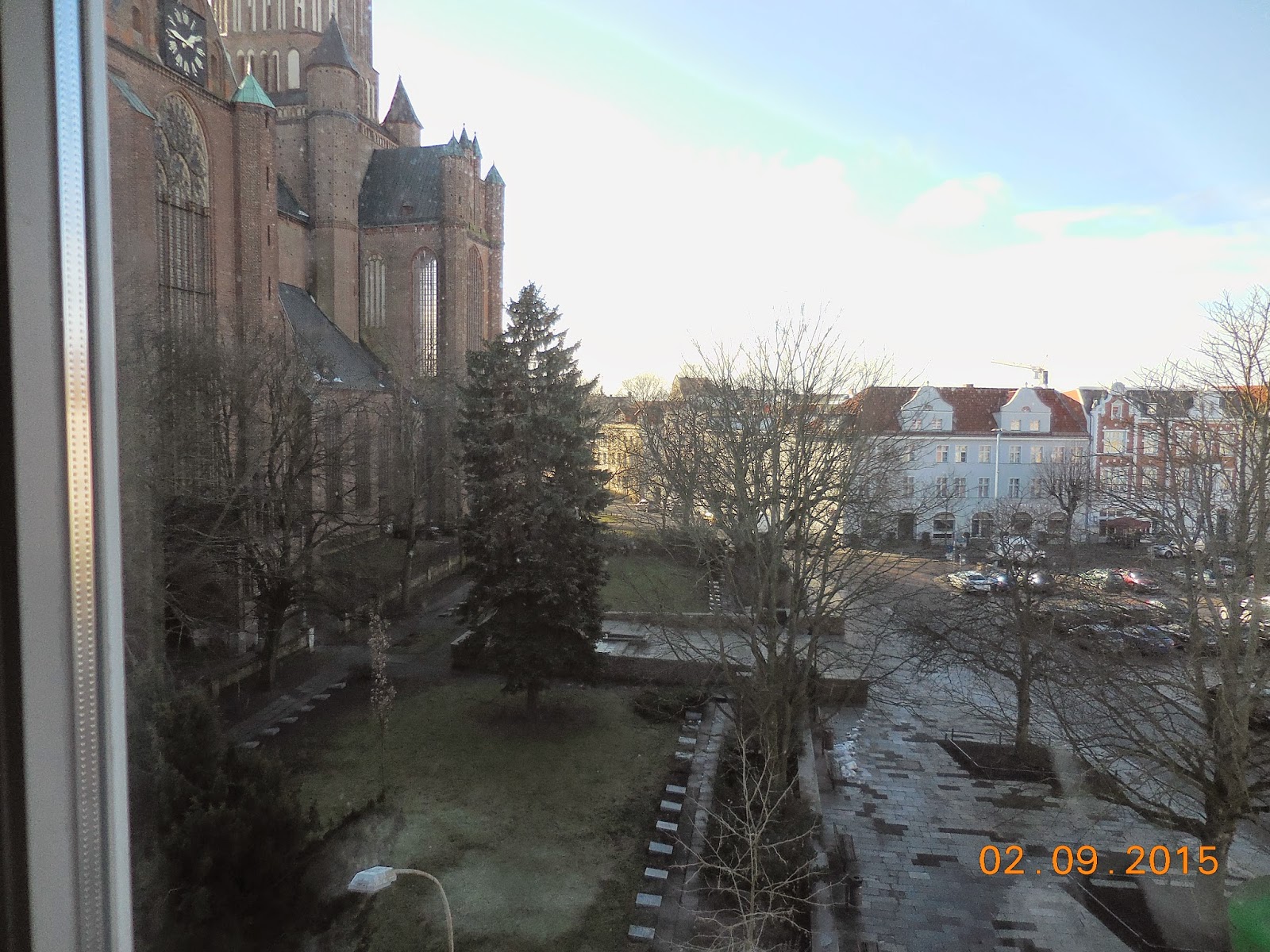
This is the view from a flat overlooking Stralsund's St. Marienkirche. Imagine looking out your living room window and seeing this! I could get used to this life, especially because directly below this flat, on the street level, is a city bakery. . .


. . . and down the street is Angela Merkel's office . . .
. . . and lots of places that look like this:


Beautiful!

Twenty minutes by train from Stralsund is the town of Greifswald, the home of the oldest Swedish university: the University of Greifswald was founded five years before Columbus happened upon the West Indies. 

All the ships arriving in Greifswald have to pass through this little fishing village at the mouth of the river Ryck, and have done this since the 13th century. 


In Greifswald we stayed with Gary's former colleague, Georg and his partner Angie, in their home overlooking a bird sanctuary. At night, hundreds of swans fly in to spend the night on the bay there, to be safe from foxes. The swans spend their days in farmers' fields, just like the Canada geese do in Minnesota. 

Yesterday, we got a tour of the university's new dental school, which was very well designed -- full of light from floor-to-ceiling windows -- and which I forgot to photograph. Along the way we met these fellows, who were about to be installed in a new dental classroom and were eager to get started. 


Sunday, February 8, 2015

The Priwall Peninsula


Today we took our usual Sunday walk along the Baltic Sea at Travemunde. This time, we took a small ferry to reach the Priwall Peninsula, across the Trave River from town.


We braved the cold wind and walked out along the beach, which is much more wild than the beach near the west side of the river at Travemunde. The reason for this is because the Priwall was a military zone and was off limits until 1989; it was the northern end of the border between East and West Germany.
(I read that in 1975, a nudist beach was opened on the Western side here, within sight of an East German watchtower. It was apparently popular among a certain set to have one's nude photo taken with the watchtower in the background. I think that is a very appropriate response, and also I think it was probably a much-sought after military post.)

Before heading back across the river, we stopped in a little cafe for a hot drink, and found that they offered not only gluhwein but also grog. I’d never seen grog on a menu before, and would have ordered one, but it was too early in the day. I really have no idea what grog is, and still don’t know, sadly, but next time I see it on a menu, I’m ordering it. It's twice as expensive as gluhwein so it must be twice as good, right?


This photo is the watchtower I mentioned earlier. Fortunately, it no longer exists, but apparently the nude beach is still there. Not today, though -- much too windy and cold!